Thursday, August 18

Abandonment: Issues from My Youth

Abandonment: the action or fact of abandoning or being abandoned

Abandonment fears typically stem from childhood loss, such as the loss of a parent through death or divorce, but they can also result from inadequate physical or emotional care. These early-childhood experiences can lead to a fear of being abandoned by the significant people in one's adult life.

An unexpected decision
Brings powerful thoughts
And emotions
Near the surface of my sleeves
Do I speak
Of the fears and anxieties
Nimbly crawling
Meticulously gnawing
Endlessly
Nervously
Throughout my skull

Family is a peculiar unit. Does this consist of only those whom are of your genetics? (i.e. blood relations- Father, Mother, and siblings). Or does this term extend to those who care for you most? Many of us stand at odds with those we are born to, and as a result we adopt the term, or are defined as “Black Sheep” by others. These abnormal, abstract, outcast, outliers are the focus of my attention as I struggle with my volatile emotions.

I was born to a family who lived in Magna, Utah. Their chosen religion, and the religion of their parents is the Church of Jesus Christ of Latter-Day Saints (e.g. “Mormons”). For those of you who are not from this state, or are not familiar with the religion, it is a peculiar one with around 13 million members worldwide; and no they do not have multiple wives- the LDS Church outlawed the practice in 1890. This religion preaches moderation in all things, and abstinence of many things.

The religion teaches their congregation to refrain from the use of drugs, alcohol (which is a drug, and to this day I always wonder why I have to list both), sex before marriage, no hot drinks (tea, coffee, and similar drinks), vulgar/profane language, obedience of the ten commandments, among many other things. As you can already tell the many restrictions and prohibitions imposed upon the followers of this faith can be difficult for a curious mind to follow; I have an extraordinarily curious mind.

After many years of exposure to people whose lifestyles and ideas differed greatly from those of my parents, I was overwhelmed by a desire to experience life, without the shackles of religion. So I ventured into the world and tasted the fruits of the various trees growing on this earth. This caused a rift to form between my parents and I- one that has never fully closed.

 When I was about fourteen years old an emotional interaction between my father and I caused him to order me out of his house. I gladly accepted and packed a bag. When I was seventeen this happened again. After staying with a friend for about a week one of my sisters caught wind of what had happened, and she invited me to stay with her. Within a short time (I cannot recall the exact time frame) my parents (most likely due to the prodding of my mother) invited me back home.

I attempted to be LDS again when I was sixteen. This lasted a brief six months, but the appeal of knowledge and experience persuaded me once again to leave their religion- this time the decision was final. We had many arguments, and even some that led to physical altercations. Now, do not judge my parents for a second- this was not child abuse. They are excellent people who did not understand how to handle a son whose language was articulate and disrespectful- most, if not all of the physical altercations were caused, and started, by my volatile emotions, and my inability to control my emotions; due to my immaturity, and something I did not become aware of until later in life.  

Emotions are something  I have always struggled with; partly due to the teachings of my father, and partly due to my own nature. My pops would always tell me growing up, “let it go”. Instead of discussing my internal fears and anxieties I would try to “let it go”; in reality this would mean the emotions would be buried until something would cause them to rise to the surface, and I would unleash a tirade on someone who usually did not deserve such treatment.

The further I moved away from their beliefs; the more I disbelieved in the concept of  “God”; the more strained and distant our relationship became. People are always attracted to those with similar interests, so it is no surprise that this occurred. Most of what I do is prohibited by their religion, or of no interest to them. However, I cannot see why anyone would support what I do when my own family does not.

I write music and stories. Unless I force them to sit down to listen to a song, they have no desire to listen to the music I create. The book I wrote, that my pops drew the cover art for, has not been read by them or any of my siblings. No matter how many times I ask for their feedback, I get none.

What bothers me most is this idea: that no one else will care what I do because my family is not supportive; and in some weird way I think that my creations lack the connectivity of the love that stems from the support a family gives to their members.

I feel disconnected from the world because I feel disconnected from the family I was born to.

I was struggling with the meaning of life, with a desire to live, so I went to therapy. The sessions I attended focused an insightful lens onto my internal universe. My emotional outbursts throughout my childhood, adolescence, and adult life flooded my mind. It all made sense now. The struggles I have with anger; the difficulties I have with communicating my thoughts and emotions; the contentious relationship with my parents; a debilitating, crippling apathy; an almost relentless, indomitable desire to rebel against any authority figure; all derived from the disassociation from my authentic self. 

The abandonment I had felt, the loneliness I had suffered,  dissipated to an extent when I learned what the root cause of my instability, and lack of self-control was. Now I could manage it. She taught me how to manage my condition, so that it would not continue to be a negative factor in my life- something I will be forever for. Recovery is not an easy task though, and there are many challenges to learn from. 

I am a very independent person, and I do not want people to think for a moment I require help. Psychological conditions are often received negatively, as though they will impede on your ability to live a successful life. My condition affects my understanding of social queues (I miss a lot), my eye contact, and my emotional intelligence and maturity; but in no way does this prevent me from being able to assimilate well enough to remain unnoticed.

I do not want my parents to feel guilt from the thought, “I did not do enough for my son.” They did all they could with what they had, and with what they knew. A few weeks ago my pops called me. His voice was nervous and shaky. Like any time he wants to discuss a specific topic, he small-talked his way around why he actually called me. After listening to idle banter for a few minutes I asked him, “Why did you call?”

“Your mother and I were thinking about selling the house and moving to Maryland with your sister.”

I was silent.

He began to list his reasons. They were damn good. He will be sixty this year, and he earns less than he has his entire life. The back-breaking labor he did throughout his 30 years of construction have left him an aching shadow of his former self. Moving to Maryland would give him the opportunity to retire (if he stayed here he would work for Salt Lake County until about death, or 80 years old; whichever came first). More importantly, moving would place him in the same house as that which brings him the most joy, his grandchildren.

Once he was done listing his reasons he asked me, “What do you think?” The question fills my eyes with tears, and chokes the air from my throat. Rarely has he asked me such a question. Throughout my entire life he always wanted to tell me “the way it is; the way to become a man.”

My response surprised me. I told him that too many people in this country live to work, and that is all that he does. He helped my mother raise five incredible children, and he worked his ass off (2-4 hour side jobs [mostly concrete] were a norm after his daily 9 hour grind) to provide the best life he could for his children. He told me he did not want to leave my sister and I hangin’; and I told him it would be selfish to tell him to stay.

Once again I followed the direction of my father, and attempted to ‘let it go’. However, my emotions are too strong to ignore. The abandonment issues of my youth have returned with an unbelievable force. I do not want to express this to my father because I do not want him to change his mind. What he is doing is the best decision for him, regardless of the consequences it imposes upon me. I am utterly confounded by the conflict I now endure.

Should I tell him? Should I not tell him? The answer seems simple and straightforward, yet I stay silent due to the idea that him not knowing is the best for him. But I must ask, what is the best for me? And to this question I have no answer.

His house will be sold within a few weeks, and he will be living in Maryland with my sister. I will have one sister left nearby, who is looking for employment outside of Utah, so that she can gain new experiences, and expand her knowledge of the world. Although I have supportive and loving friends, I cannot help feeling a powerful sense of loss, disappointment, and most of all abandonment.

To those of you who you suffer from the same I wish you solace in your darkest times. Know that you do not suffer alone. There are many like us, and these challenges will only strengthen our characters. When we put the needs of others before our own, our selflessness creates a positive change in the attitude of those people. We are the arbiters of progress.

All My Love

Laron R. Lemon


Wednesday, August 3

Climbing: How a Sport Transformed my Life

Discipline: the practice of training people to obey rules or a code of behavior, using punishment to correct disobedience.

While living with my friend “Nile the Crocodile” I was introduced to climbing. He convinced me to join a local gym named Momentum. I had seen videos of rock climbers before, and thought to myself, “I can do that”. At the time I was working two jobs and was constantly on the move. I thought I was fit- boy, was I in for a surprise.

Sports have always been an integral part of my life. My father was insistent that I would be an athlete. He enrolled me in basketball leagues since before I can remember, and I played American Football once I was in Junior High School. Baseball, soccer, tennis, and other traditional sports were played whenever I had down time, and was not playing video games.  Like many people, I became disillusioned during my teenage years and gave all of these traditional sports up completely; leaving me an obese pile of health issues.

Between the ages of 17-22 I ate poorly, drank heavily, and abused many different drugs (no meth or heroin though). One day while I was wallowing in self-pity I found a manila envelope addressed to me. The chicken scratch handwriting could have only been that of my past self, and I did not remember it at all. Inside was writing from my High School days- evidence of my angst, anger, and anxiety; frustrations with the life we are told to live; and a powerful note from my English teacher. I realized at that moment I had to change who I was.

I started to do the only exercise I could at the time: walking. I weighed a little over 235 lbs. At 5’8” tall that is an extremely unhealthy weight. Acid reflux, shortness of breath (smoker’s lung), diarrhea, excessive mucous, joint problems, and many other ailments plagued my daily existence. My parents offered to give me an old bike they had, and I gladly accepted. A park near where I lived at the time has a one to two mile loop, and my first ride around was quite embarrassing- I was panting half way through.

Bills were piling up on me, and I wanted to rid myself of the social influences that enabled my unhealthy behaviors. A new employment opportunity was a light at the end of this dark tunnel, but I thought at the time that I needed more help. While discussing this with my parents they offered to allow me to stay with them, until I was back on my feet. The only condition they had for me was that I continue on the path that I had chosen; a path to improve my life.

During the ten months I lived with them I had a very strict routine. I would wake up at 5:30 to go to work. When I would get home I would head straight to the gym to run. By this time I was fit enough that I could run a mile in about eight minutes. The treadmill bored me. On the televisions nearby there were always shows on that were not of my taste, and so I began running on the track. Soon I was jogging up the stairs, and even skipping some as I went.

With my newfound financial freedom I was able to focus on buying foods that were healthier (something people do not realize, until they live in poverty, is that unhealthy food are more inexpensive). I found several books on nutrition (including two written by a cousin) and learned what I could do to enhance my ability at the gym. I pushed harder every day, trying to get back to that seven minute mile.

One day I arrived home with way more energy than I was used to, so I decided to jog to the gym. Much to my surprise the last month of running had paid off so well that I was able to jog back to my parent’s house (which was two miles from the gym) after I had ran two miles at the gym, and ridden a stationary bike for five miles. My gym schedule was at the same time as some younger people who played basketball there, and I worked this into my daily routine.

Every day I would race home from work so I could get to the gym. Before long my hourly routine turned into two, than three hours. I was addicted to exercise, and spent most of my time away from work at the gym. When I would get home I would cook dinner- chicken or fish with green vegetables (my mother loved this part of me being home). Afterwards I would read a book for between 1-2 hours, play the piano, and go to bed. Rarely did I watch television.

There was a day where work had made me extremely anxious, and the idea that I was living to work weighed heavily on my mind. I ran to the gym after work and was sprinting around the track upstairs when an old friend from high school saw me. He walked up from the weights and stood in front of my path, with concern in his eyes. “Are you smoking meth?” He asked. We both laughed.

The last time he had seen me was when I weighed 235 lbs, and by that time I was down to 145 lbs- just a year and half later. It was no surprise he would ask such a question. He told me I had to start lifting with him, whenever he was there at the same time as me. I agreed without hesitation. He taught me how to build lean, strong muscle.

Around this time Neil moved out of the apartment he was in, and wanted another roommate; I jumped at the opportunity. Soon after moving in he started to show me the collection of snowboarding and climbing videos he had. Climbing peaked my interest, so we decided to join Momentum.

My level of fitness was at a five year high. The first time I went to Momentum I thought I was going to be able to climb all of it; I was humbled.

To my left and to my right were men and women who did not appear to be as strong, yet they would climb up and down these plastic holds with ease. I was dumbfounded, I was flabbergasted, and I was a little frustrated. Were all of these years of exercise for naught?

For six months we climbed at least three days per week. During this time I met exciting people who were always ready to go out to party. I was young and full of energy. I worked two jobs, climbed, and wanted to experience all that I could. Unfortunately, rest is something that has always alluded me. I would only sleep between two to four hours per night, and the toll this took on my mind and body eventually caught up with me.

One morning after a friend’s wedding I was on my back from getting food and I lost consciousness while driving over the I-80 freeway along 1300 East going southbound. After many tests it was concluded that my heart lost pressure, and the lack of blood flow (i.e. oxygen) to my brain caused my syncope. I discussed my night life, my love of cocaine, and my lack of sleep with a cardiologist and a neurologist- each gave me a grave warning; I would be dead by thirty if I continued the life I was living (surprisingly both were supportive of smoking marijuana).

This car accident injured me- mentally and physically. I hobbled around in melancholy and self-pity for several months, until I left the law firm I had worked for to join a health insurance company. Here I met someone who was into weight training to build muscle mass. He taught me how to properly circuit train, and helped me regain my mental and physical strength, as well as the confidence I had lost.

Nile the Crocodile and I parted ways for over a year and we did not climb at all during this time. He moved closer to the Cottonwood Canyons (Utah) and I moved near downtown Salt Lake City (Utah). Eventually he decided to move closer to downtown. Neither of us had a car at this time. We would bike everywhere. One day I received a knock on my door. I opened the door to find Nile the Crocodile acting very unlike himself; he was excited- his words flew out of his mouth at a million miles an hour; he told me, “We NEED to build a climbing wall in your back yard”.

I okayed the idea with my landlord. Over the next few days I discussed possible ideas with my friends and family who were thoroughly involved with residential and commercial construction. The idea we committed to was an eight foot by fifteen foot wall with two sections. The first section is set on two foot box, at a 45 degree angle. The second is completely level (oh yeah) at a zero degree angle.

We climbed hard on this wall almost every day. Of course not everyone has the same convictions. People came and went, but the wall remained in my backyard- a constant reminder to send it.

I had never thought of climbing outside, in the mountains before, nor had I thought of doing so. When I was young my father and mother instilled a profound love and respect for the great outdoors. We backpacked and hiked regularly. I had seen people climbing before, but never really given it much thought. A friend of mine took me outside and I was terrified- an experience from my childhood haunted me.

I will not go into much detail about my childhood trauma, since I have written about that experience in detail already. Here I would just like to note that a family trip to some arches in Utah caused me to succumb to acrophobia.

This is when I met my last ex-girlfriend. We trail ran together, and I slowly climbed less and less as we spent more time together. This was no fault of hers. She did not climb, and I wanted to spend time with her. She was the light in my world, for a time. After nine months of bliss she moved in, and that is when it fell apart.

A month after we split (January of 2015) a friend of mine who had moved back to Seattle, Washington to be close to his son moved back to Utah for a job opportunity. He convinced me to climb outside with him.

It was an unusual winter in Utah that year, and barely snowed at all. So we hit crags from February until May, and it was awesome. My friend shacked up with a lady and moved in with her, limiting the number of days we could spend climbing together; it was time to buy gear. (:

Gear, gear, gear! I piled it on, and slowly chipped away at my fear of heights. I led my first 5.9, Hollow man in BCC, and took my first thirty feet plus whipper (fall). Than the day I sung my heart out on choir boy (a 5.9 climb in BCC) arrived. After that it all seemed to fall into place. The fear of  falling, the fear of heights subsided for a time. Our crew of climbing partners moved rapidly from 5.8-5.10c ratings.

I was laid off from the firm I was working for in June of last summer (2015), and given the opportunity to claim unemployment, on top of the severance package they provided. This interesting experience presented another opportunity; an opportunity to climb. I embraced the dirtbag lifestyle.

For those of you outside of the climbing community this means that you live to climb. I would wake up early to climb or trail run; take naps during the day; and climb in the afternoons with whoever was available. Showers happened every so often, there was just too much climbing and resting for the next climb to be done! This continued for two and half months and I would recommend such a reprieve for any adult who is lucky enough to take advantage of such a chance.

I was head-hunted by the law firm I currently work with. I wanted nothing to do with the traditional life anymore; a sport that began has hobby had transitioned into a passion, and was now a full-blown obsession (a healthy one, of course). When I was interviewed I clearly stated this fact, and their response blew me away; they wanted me to work with their firm so that I could chase my passions.

In the few months I had spent climbing I had forgotten about how much more world there was out there to explore. My mind had narrowed onto the canyons nearby. When they told me this my mind wandered around the globe, and the possible crags I could travel to with the income they offered- it was something I could not refuse.

Of course splitting my time between work and climbing meant that I would have to be dedicated, I would have to maintain self-control, and I would have to be disciplined. It is difficult to juggle all of the balls in this adult life, but sacrifices are easy to make when you are in love.

As soon as I am done with work I race home to gather my gear and either head to a crag, a boulder field, or the Front Climbing Club, where I pay for a monthly membership. Day in and day out I climb. In addition I ride my bike to and from work, as well as trail run with my dog two to three times per week. This regimen is exhausting, yet fulfilling, and extremely rewarding.

I broke my tailbone snowboarding in mid-December of 2015 and this slowed down my progress. When I returned in  February I was more timid, more cautious, and mostly, more afraid. The fear had returned, and became an impediment to my climbing.

This may, or may not be common, but I fell victim to the silly idea that I would continue to improve at the pace I had when I first started the sport. Our crew climbed so quickly through each of the easier ratings I thought we were just that damn good. When we reached the 10c/10d range it all changed. The routes became exponentially harder. Holds were much smaller, slopers started to appear more frequently, and the walls started to have more bulges, and roofs, if not being overhung the entire time.

Gym time lost its appeal, and it was difficult to climb around people who were better than me, especially those that were younger. I lost confidence in my ability, and was soon being persuaded by my mind that this was it, this was as good as I was going to get; I had reached my limitation. One day I was at the gym and overheard a young woman tell a friend of a friend that was there that she had been climbing for a little over ten years. She was a beast, and her comment gave so much insight into my own situation; I began to add up my years of rock climbing experience- six months in the gym + six to twelve months in the backyard+ 12 months outside = 24-30 months, or 2- 2 1/2 years.

Something else, something deep in my subconscious yelled, “lies!” in response to my self-deprecation, and so I scoured the internet for more information. What I found left me stunned. Most people experienced exactly what I was at that moment: a plateau.

I changed my strategy. Instead of expecting those milestone achievements, I began to look for those incremental improvements in my technique and my strength. How could I get my fingers to hold on to that crimp? What did I need to do to be able to suck my core into the wall for that one crux move? Which edge do will give me the right angle? What direction do I need to position my hips?

These questions and many more gnawed away at my mind constantly.

Bouldering was my answer. I found several articles by very experienced climbers and alpinists who said that they would find boulders with moves like the cruxes they could not get through, and work on those problems until they felt mentally and physically ready to accept the challenge the rock had waiting for them. I met another climber during this time who got me more into Traditional climbing, which has just added to my technique, strength, and overall mental fortitude (placing gear while pumped is spicy!)

After many months of rigorous training a couple friends and I went to Haystack Mountain in the Uinta National Forest here in Utah. This was last weekend. The boulders up there are difficult (most have to be above my current skill; V7+), and require a 1 1/2 mile hike up a steep hill. We sent several lines that were between the V0-V2 range, and then we found the boulder we were looking for.

Three problems on the wall shut us down (V4-V5). We tried repeatedly to send the problems and continued to fall at the crux each time. I started to work on a problem next to one they had chosen. After several attempts, and just being utterly confused how to climb up, I watched them slap at the rock. It only took a few seconds to realize that I could send that line.

I jumped on it and gave it a go; I fell over and over. Instead of becoming frustrated I was getting more excited with every single fall because I was getting closer and closer to landing that crimp, and locking off my fingers- I knew I could send this line. It was a challenge, but it was a challenge I could complete. My fingers were getting tired, so after a good long rest I gave it “one last try”; as usual, that was all that was necessary.

I locked off my left hand on the crimp, placed my feet, leveraged my weight on my right toe, edged, jammed my toe in the crack, and threw my right hand onto the other crimp- it locked off, it locked off! Instinct overtook my senses and movements. The next three holds were visible to every sense I have. Within seconds I was on top of the boulder, and I let out a warrior cry out of sheer ecstasy.

Last night my friend who got me climbing outside- the one who moved back from Washington- wanted me to check out the limestone crag called Hellgate Cliffs, in Little Cottonwood Canyon Utah. On the east side is a wall called Melting Mud wall, with a route aptly named Cottonmouth King. When he asked if I would like to go to Hellgate this was the only route that stood out in my mind; a route rated 5.11a- something I had never led before.

The climb was a mix of underclings, crimps, sidepulls, awkward moves, touchy feet, and glorious pockets (most of which were only big enough for one or two fingers). I battled bolt to bolt and fell several times, but I made it to the top. This tremendous achievement was a small drop in the bucket of my climbing career. It is a testament to hard work, self-control, and discipline; the enormous amount of time required to improve one’s self is worthwhile.

Now I understand why so many have embraced the sport of climbing, and the lifestyle you eventually live, once you become obsessed (i.e. in love) like I am. The daily challenges, the struggles, the work, the pain, the fatigue, the money (or lack thereof), the constant sacrifices of social events to climb, and facing your fears, all lead to small victories that instill such an overwhelming feeling of joy that every fiber of my being craves for my next climb.

I have been transformed physically, mentally, emotionally, and spiritually by the rock.

These lessons inevitably affect the rest of your life. A profound appreciation for nature and all of its glory created a passion for conservation and preservation of our beloved outdoors. My attitude toward others is more positive than ever before. The small things that create beauty and joy in this world are no longer unseen by my eyes, and it is easy to point these out to others. Optimism for the future and an unwavering conviction to the work necessary to create a future I desire inspires me every single day.

Life is climbing because climbing is life. Rock climbing is a hobby that transitioned to a passion, and now it is a healthy obsession that will never allow me to become that person I once was. I am thankful every day for the people that led me down this unbelievable path, and to those that have enabled me to become a person who can inspire others to chase their own passions.

Find what you love and live it every day. When you reach your ten year mark you will have so much knowledge and experience you will be a teacher of our people, and in doing so we will create a better future together. Cheers.

Much love,


Laron

Wednesday, June 22

Sexuality

Never have I ever added a quote to my quote wall from an article online, until today. Sarah Hepola, thank you so much for your insightful comments. "...the fear of vulnerability is part of the price of real connection."

A little over two years ago a relationship which I thought was the last I would have to search for ended abruptly. At the time the devastation presented me with what seemed to be the only two options: use drugs (including alcohol) to silence my pain; or use exercise and education to distract me. I chose the latter.

Fast forward to the present. I find the sexual escapades of my youth are now ghosts of a past that barely seems recognizable because of who I have become. I yearn for intellectual and emotional stimulation before any thoughts of sexual interaction even enter my mind. Physical attractions and infatuations still occur. However, my focus has shifted from the temporary happiness of a sexual conquest, to the lasting joy of an intimate interaction with another person who understands the internal universe which is my true identity.

Since I am a heterosexual male in a patriarchal society I am expected to behave like many of my other male counterparts- i.e. satisfy my “natural” desire. Too often friends of mine say, “what you have not had sex in how many months? Why? We need to get you to a bar.” This is emasculating and disrespectful. The words convey a hurtful meaning of damn, you need some help- and shows a lack of understanding that my lack of sexual activity is a choice, not a condition of life imposed upon me because of unattractive qualities of my personality, or physical characteristics.

Statements like these also show an extreme disrespect for women- as if women are objects to possess, for the benefit and entertainment of men. This idea has persisted in human culture for too long, and I cannot find any logic that would lead to such an irrational conclusion.

This brings me to female comics, such as the terrible Amy Schumer. She, and others like her are terrible role models for women. This is what I hear behind all her theatrics, “Get drunk, be a slut, show some legs, and some cleavage- feminism!” To me this is the same side of the coin as those male friends of mine who want to have the subservient wife (she is selling the same patriarchal dogma- if a man/woman you are interested in perceives you as a promiscuous person who is a drink, convincing them of your intelligence and other positive qualities is going to be an uphill battle).

I am not saying not to engage in those activities while in your youth. Doing so will allow you to find you levels of comfort. That said, do not feel like you have to be like the Amy Schumers, or many of those male sluts you know, in order to be you. I know how difficult it can be to try to maintain your own identity in sea full of extremes. The spectrum of sexuality ranges from the prudes to the sluts, and everywhere in between. Find where you fit in that spectrum and let people hear your voice. It is the only way other people who are scared will overcome their fears. Cheers.

The Glass

You can choose to see the glass half empty or half full; or you can see the glass as a tool to create something new. Cheers. (:

Tuesday, June 21

Music as Biology: Summing Up

Coursera Online is an awesome place to learn, for anyone who does not have the funds, or for those who do not want to be indebted in order to learn. I wish you all the best.

coursera.org


Music was created as an expression of the perception of the composer, in regard to our shared human condition. Initially, our natural biological functions limited our use of sound in music (speech and sensory organs). The advancement/evolution of technology, and our inevitable dependence on the technology we create, stimulates the attraction to industrial, mechanical, and other forms of non-biological sounds, as these sounds become more prominent and "normal" throughout human civilization. Music is an extension of our desire to understand the universe, and in searching for the answers of our external environments we begin to answer the questions about our internal universes. The biologic composition of our bodies sets the limits of our music only as far as our technology extends those limitations and parameters. I am overjoyed I took this course, because I love to experiment with music theory, and the limitations of human hearing. Cheers.

Thursday, June 2

Suicide

SUICIDE

National Suicide Prevention Lifeline
1-800-273-TALK (1-800-273-8255)
[United States ONLY]

Today is another day of mourning. Someone I once knew, who was respected by all that knew her, decided it was time to leave this world. The consequences resulting from her decision will impact those close to her, as well as those of us who were influenced by experiences we shared with her.

“I think suicide is sort of like cancer was 50 years ago. People don't want to talk about it, they don't want to know about it. People are frightened of it, and they don't understand, when actually these issues are medically treatable.”
-Judy Collins

Let’s start with some definitions:


Suicide
·         Death caused by self-directed injurious behavior with an intent to die as a result of the behavior.
Suicide attempt
·         A non-fatal, self-directed, potentially injurious behavior with an intent to die as a result of the behavior; might not result in injury.
Suicidal ideation
·         Thinking about, considering, or planning suicide.

“There is but one truly serious philosophical problem and that is suicide.”
-Albert Camus

The stigmatization of  people with mental health issues ends now! Too often people do not seek the help they desperately need  to avoid being labeled as someone who cannot handle the stressors of life- psychological and  physiological. “Broken”, “Disturbed”, “Insane”, “Brain Dead”,  “Handicapped”, “Stupid”; these are just a few of the labels used to demonize someone with a mental illness, and to worsen their mental health.

“They tell us that suicide is the greatest piece of cowardice... that suicide is wrong; when it is quite obvious that there is nothing in the world to which every man has a more unassailable title than to his own life and person.”
-Arthur Schopenhauer
National Suicide Prevention Lifeline
1-800-273-TALK (1-800-273-8255)
[United States ONLY]

Here is a link to 250 labels used for people who are afflicted by a mental health illness published by the National Center for Biotechnology Information, National Library of Medicine, National Institute of Health:

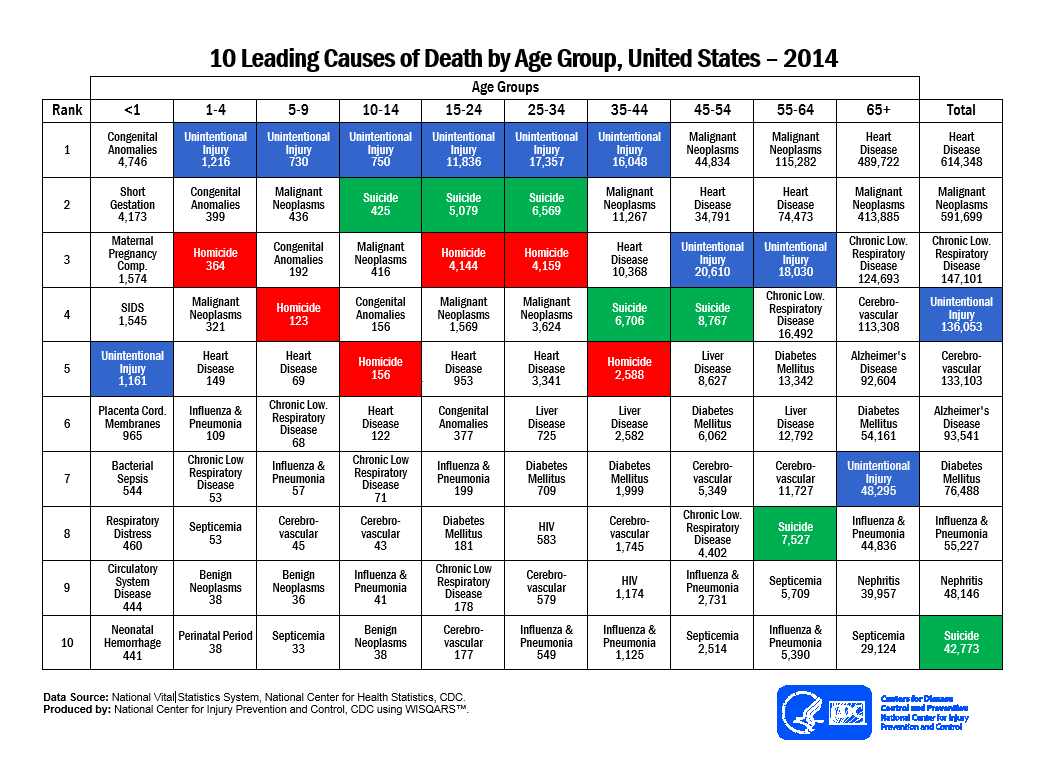
Why has suicide become an increasingly popular way to die?  Statistics do not lie. Younger and younger people choose to end their lives, to end the suffering they endure.

“It is always consoling to think of suicide: in that way one gets through many a bad night.”
-Friedrich Nietzsche


Here is a link to the CDC 10 leading causes of death by Age Group, United States- 2014


·        Suicide is the 10th leading cause of death among Americans.

As you can see Suicide was the second leading cause of death amongst 10-34 year olds. To put this in perspective this would include anyone born from 1982-2006. For anyone between the ages of 35-54 (1972-1981) it is the fourth highest leading cause of death. Why?

“Suicide is a permanent solution to a temporary problem.”
-Phil Donahue


National Suicide Prevention Lifeline
1-800-273-TALK (1-800-273-8255)
[United States ONLY]

According to the CDC:
Risk Factors
·         Family history of suicide
·         Family history of child maltreatment
·         Previous suicide attempt(s)
·         History of mental disorders, particularly clinical depression
·         History of alcohol and substance abuse
·         Feelings of hopelessness
·         Impulsive or aggressive tendencies
·         Cultural and religious beliefs (e.g., belief that suicide is noble resolution of a personal dilemma)
·         Local epidemics of suicide
·         Isolation, a feeling of being cut off from other people
·         Barriers to accessing mental health treatment
·         Loss (relational, social, work, or financial)
·         Physical illness
·         Easy access to lethal methods
·         Unwillingness to seek help because of the stigma attached to mental health and substance abuse disorders or to suicidal thoughts
“Cutting, and suicide, two very different symptoms of the same problem, are gaining on us. I personally don't know a single person who doesn't know at least two of these victims personally.”
-Pink

“Fame is no sanctuary from the passing of youth... suicide is much easier and more acceptable in Hollywood than growing old gracefully.”
-Julie Burchill


National Suicide Prevention Lifeline
1-800-273-TALK (1-800-273-8255)
[United States ONLY]
To answer the question as to why, I think an evaluation of federal government spending will help us.
https://media.nationalpriorities.org/uploads/discretionary_spending_pie,_2015_enacted.png


National Suicide Prevention Lifeline
1-800-273-TALK (1-800-273-8255)
[United States ONLY]

The federal government spends about six percent on Medicare and Health combined. Exactly how much funds federal, state, and local organizations receive and use specifically for mental health are debatable, due to the unreliability of sources, and the lack of a system to adequately track such information. The estimates I have found range anywhere between 1%-5%; i.e. 3-5 billion dollars. Some go as high as 7 billion, but I cannot verify the accuracy of this information. The entities in the following list are where I found the above:
World Health Organization, National Alliance of the Mentally Ill, Penn State University, Agency for Healthcare Research, just to name a few.

There is too much emphasis on Military spending; this much is blatantly obvious. The tools of conflict and fear have been used to persuade the citizens of this country to be idle while the military-industrial complex cripples other industry, undermines our educational institutions, and degrades the mental health of the citizens of this country.

It is not surprise to me that people who were born after 1980 are more susceptible to symptoms, and are more likely to choose suicide over life, than those of previous generations. Why is this? The United States has been at War for most of the last century. What is different?

Ethics. The wars of the first half of the century involved many nations who allied to prevent tyrannical powers from usurping national and international governing authority. Since 1990 the United States has been involved with conflicts in Eastern Europe and the middle east, which have questionable motives. Oil (maybe other resources too), strategic geographical positions, political and economic influence, and isolated economic prosperity are a few of the reasons for these wars and conflicts.

Our species is inherently inclined to be compassionate. This is due to our subconscious understanding that our species is more likely to survive, if our overall number is greater (as population size increase so does our statistical probability of survival. Therefore, these irrational, and unethical conflicts and wars the United States Government, in association with the Central Intelligence Agency, have cause a mental dilemma for anyone witnessing these events.
National Suicide Prevention Lifeline
1-800-273-TALK (1-800-273-8255)
[United States ONLY]

The stagnation of wages, coupled with the inflation of costs for goods and services only strengthens the stressors endured by individuals already afflicted by this Philosophy of War adopted by the United States of America.

Some of you may not know this already; I once succumbed to the overwhelming power of apathy insomuch this life did not seem worth living. The aforementioned ideas, in conjunction with my desire for freedom from my own suffering (the human condition), stirred a passion to choose suicide. I was lucky. Friends and loved ones retaught me the value of life, and years of therapy rehabilitated me into the person I am today.

"If God does not exist, then all will is mine, and I am obliged to proclaim self-will."  Alexei Nilych Kirillov
            - The Possessed (Demons) by Fyodor Dostoyevksy

“Suicide is man's way of telling God, 'You can't fire me - I quit.'”
            - Bill Maher

What are the consequences of such an action?

According to the CDC:

Costs to Society: The following estimates are based on 2010 CDC data and refer to people age 10 and over.2
·         Suicide costs society over $44.6 billion a year in combined medical and work loss costs.
·         The average suicide costs $1,164,499.

Survivors: A survivor of suicide is a family member or friend of a person who died by suicide.
·         Surviving the loss of loved one to suicide is a risk factor for suicide.3
·         Surviving family members and close friends are deeply impacted by each suicide and experience a range of complex grief reactions including, guilt, anger, abandonment, denial, helplessness, and shock.4,5
·         No exact figure exists, but it is estimated that a median of between 6 and 32 survivors exist for each suicide, depending on the definition used.6
·         According to another estimate, approximately 7% of the U.S. population knew someone who died of suicide during the past 12 months.7


National Suicide Prevention Lifeline
1-800-273-TALK (1-800-273-8255)
[United States ONLY]

“When you’re young and healthy you can plan on Monday to commit suicide, and by Wednesday you’re laughing again.”
 – Marilyn Monroe


What is the Impact of Suicide within the United States?

“We look for the sermon in the suicide, for the social or moral lesson in the murder of five. We interpret what we see, select the most workable of the multiple choices.”
-Joan Didion

Each year, more than 39,000 Americans end their own lives, nearly 500,000 people are treated in U.S. emergency departments for self-inflicted injuries, and 1 million adults report making a suicide attempt. Many more people struggle with thoughts of suicide.

Suicide is a serious public health problem that affects people of all ages. It is the 10th leading cause of death for Americans overall and the second leading cause of death among adolescents and young adults aged 15-29. Suicide and suicidal behavior can have devastating effects on individuals, families, schools and communities.

Here is a link to prevention strategies listed on the CDC website:
“Did you really want to die? No one commits suicide because they want to die. Then why do they do it? Because they want to stop the pain.”
– Tiffanie DeBartolo

Buddhism is a philosophy which also helped me on my path to recovery. The First Noble Truth is that life is Suffering; the Second Noble Truth is to determine the cause of Suffering; The Third Noble Truth is the End of Suffering; and the Fourth Noble Truth is Attainment of the End of Suffering. The eight steps to achieve the Fourth Noble Truth are Right Understanding, Right Thought, Right Speech, Right Action, Right Livelihood, Right Effort, Right Mindfulness and Right Concentration. Three themes govern your eight steps: good moral conduct (Understanding, Thought, Speech), meditation and mental development (Action, Livelihood, Effort) , wisdom or insight (Mindfulness and Concentration).


National Suicide Prevention Lifeline
1-800-273-TALK (1-800-273-8255)
[United States ONLY]

Suffering is a sensation all of us endure- psychological and physiological. People often tell me how positive I have become, and all I can do is be grateful for all of those who suffered before me, and left their knowledge of how to understand it, and more importantly, benefit from your suffering. Life, both the negative and positive, is an experience so abstract it should not even exist. This is why after learning of Buddhism I try my best to appreciate every experience I live.

“No law can give or take away the choice to commit suicide.”
-Maggie Gallagher

It is our responsibility to educate and empower our fellow people to live healthy and positive lives. We cannot expect congress to act on our behalf. We must act. You and I are the only people who can choose to address this issue. In doing so we can begin to address all of the issues that are correlated to our mental health.

First and foremost, we must stop using the terminology “commit or committed”. This is the linguistic equivalent of calling someone insane, and when either is used it can cause the listener to equate the act with someone who committed murder or rape. These people chose their end. Never forget that. Remember the words you choose to use affect those who hear the sounds.

Second, we must stop stigmatizing those who suggest they might be depressed, overly anxious, or state they cannot handle the stressors of their life; this can be exemplified with body language, as much as speech. People go to school for many years to learn how to rehabilitate those who are afflicted with a mental illness. Many times our internal dialogue convinces us our struggle is an individual form of suffering, that no one could ever understand. This ideation is debilitating, and often prevents the tormented from seeking help. Be aware of those around you, and assist those you see with symptoms by directing them to the help they need.

Third, we must create a national system of reliable statistical information so that we can determine where funding is most needed. This leads to my final point.


National Suicide Prevention Lifeline
1-800-273-TALK (1-800-273-8255)
[United States ONLY]

Finally, we must address government spending. This will be the most difficult because of the divisive nature of politics, and the asinine behaviors and ideologies of our current senators and congressman. We need new people, within the affected demographics to sound their collective voices so that we can create positive change in this country.


Other Useful Information:

Protective Factors
·         Effective clinical care for mental, physical, and substance abuse disorders
·         Easy access to a variety of clinical interventions and support for help seeking
·         Family and community support (connectedness)
·         Support from ongoing medical and mental health care relationships
·         Skills in problem solving, conflict resolution, and nonviolent ways of handling disputes
·         Cultural and religious beliefs that discourage suicide and support instincts for self-preservation
The following information is the Mental Health Ranking of the States of the United States of America: http://www.mentalhealthamerica.net/issues/ranking-states

National Suicide Prevention Lifeline
1-800-273-TALK (1-800-273-8255)
[United States ONLY]

Here is a link to the World Health Organization Chart documenting mental health and suicide rates: http://gamapserver.who.int/gho/interactive_charts/mental_health/suicide_rates/atlas.html


This is dedicated to all of the flowers who wilted, and cast aside their petals too soon. I wish upon these departed people the peace and tranquility their tormented souls craved. I send you my love.


- Laron

Tuesday, April 12

Atheism: a misunderstood lack of belief

Okay, so here is my rant for the day. Too often religious people criticize atheists like me for the lack of belief. It is crazy! Many of these religious zealots resort to insults in regard to the characteristics of a person who is atheist, and frankly, most of what is said is just downright false. A lack of belief does not mean a lack of morals and ethics. Those are both learned from your parents/community, and determined by the individual. Choosing not to believe in something that has never been proven to exist does not lead to criminal acts, or unhealthy behaviors- that is the choice of the individual and the circumstantial effects which determine their mental health. 

Here is a small list of what being an atheist will cause in your life (according to idiots): 

1. Homosexuality
2. Rape
3. Murder
4. Quick-Tempered

Here is my response to all those who really do think Atheism will cause you to be less of a person: 

I am a witch who rapes profane languages because of my naïve reasoning that explains my quick-tempered, murderous rages. Crime is a constant in my life because of the magical properties of the charm bracelets (yes multiples) that line each arm, and one leg; yes only one leg, I am not going overboard here. My mornings start with the worship of satan, followed by some kix. After I am nutritionalized I worship Succoth-Benoth, Nergal, and Nibhaz simultaneously. Lunch usually consists of sucking blood while I live in fear of my own mortality and the eternal damnation which awaits me in the afterlife.

Once the blood settles in my stomach I reflect on how doomed I am, I go outside to see how many people I can lie to, and how many people are easily tricked. Having such a corrupt heart is pretty tiring stuff, so I take a quick nap so that I can start planning the next evil I am going to unleash onto the world. With the billions of wickedness in my chromosomes activated from my daily foolishness I consider how homosexual I can be, until I fall to sleep- where I will dream of worshiping false gods.